Photo Courtesy Tracy Brown
More on the Sewage Contamination in the Hudson River
This project is conducted in collaboration with scientists from Columbia University’s Lamont-Doherty Earth Observatory and Queens College. It is part of Riverkeeper’s Swimmable River Campaign, which aims to improve the water quality of the Hudson through better water quality policies, better wastewater treatment infrastructure and better monitoring and public notification of river conditions.
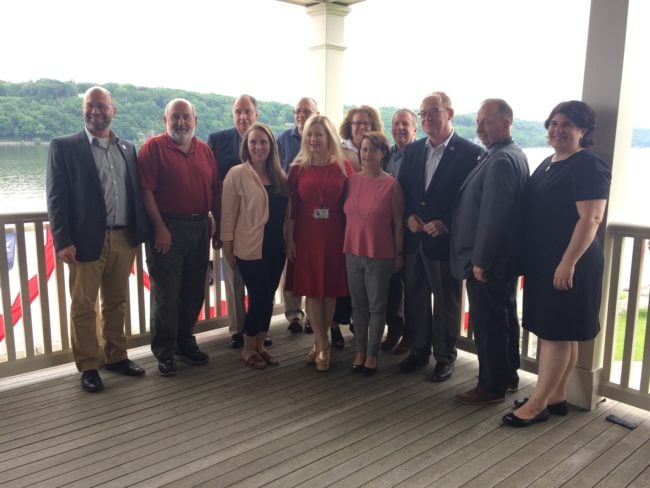
Meet our water quality program partners
Feature video from EcoCentric – Heroic Endeavors: Testing the Waters – Riverkeeper Watches Over Hudson River Water Quality
In a break from current water testing practices, Riverkeeper has launched a program to take samples the length and breadth of the Hudson – at deep-water sites, boat launches, public piers, swimming beaches, mouths of tributaries, and off wastewater treatment plants –and then bring the results to you, the public.
Before this program started, water testing on the Hudson was not happening very often, samples were only taken from the middle of the river, results were expressed in averages and general trend, and it was hard for the public to get hold of the information.
Using our 36-foot patrol boat, Riverkeeper and scientists from Lamont-Doherty Earth Observatory of Columbia University and Queens College of the City University of New York have tested more than 1,000 samples from over 80 locations and published the findings online.
Hudson River water-quality data posted to the Riverkeeper website are made freely available to the public, and we encourage their wide use. However, if you use the data for research, policy, or educational purposes, we would appreciate that you let us know so that we can document that use for our funders (which will help us continue this service).
Please do not post any data from the Riverkeeper website directly on any other website. However, linking to the Riverkeeper website, or to individual pages on the Riverkeeper website, is encouraged.
If the Riverkeeper website data are used as background or ancillary information for any presentation, publication, website, or educational product, we would appreciate proper acknowledgement (Data collected by O’Mullan GD, Juhl AR, and Lipscomb J, available at www.riverkeeper.org. Funding provided by Hudson Riverkeeper, the Wallace Research Foundation, the Brinson Foundation, Lamont Doherty Earth Observatory of Columbia University, and CUNY Queens College).
If you would like to use the Riverkeeper website data as an integral contribution to any publication or educational product, please contact us to discuss potential collaboration and appropriate determination of authorship.
Please contact us if needed to inquire about additional data that may be available and about QA/QC procedures.
Thank you for respecting the efforts of many individuals that have gone into collecting, processing, maintaining, and disseminating these valuable data.
Riverkeeper’s Clean Water Action Agenda calls for:
1) Frequent monitoring and public notification
2) Passage of a New York State Sewage Right to Know Law
4) Wastewater infrastructure upgrades
5) Local actions to address local sources of sewage contamination
Riverkeeper, Lamont-Doherty Earth Observatory and Queens College set out to begin characterizing the complex water quality conditions in the Hudson River Estuary. Our initial findings from 2006 and 2007 show overall water quality to be highly variable depending on both site location and time sampled. This study is ongoing and as the data increase, a better picture of problem locations throughout the estuary will emerge. Learn More
The Riverkeeper water quality study measures salinity, oxygen, temperature, suspended sediment, chlorophyll, and the sewage indicating bacterium Enteroccocus.
The data collected does not include analysis of water or soil contamination that may result from polychlorinated biphenyls (PCBs), radioactivity, mercury, heavy metals, or other industrial contaminants. Learn More
Monthly cruises were conducted on the Riverkeeper patrol boat, RV Fletcher, to collect samples from the Hudson River. From September 2006 to September 2007, two hundred fifty-two (252) samples were collected monthly from twenty-seven (27) sampling stations from the Battery in New York City to Peekskill in northern Westchester County.
Approximately 40 additional testing locations were added in 2008, extending the study from the New York City Battery to just above the confluence of the Mohawk and Hudson Rivers at Waterford. As of early 2009, nearly one thousand measures of sewage indicating bacteria have been recorded and posted to the web site.
In addition to continuous characterization of the environment using sensor systems, discrete samples were taken at 27 stations on the Hudson River. Each site falls into one of four categories: 1. Midchannel, deep water; 2. Sewage outfall; 3. Tributary; 4. User location (boat launch or swimming beach). Together these sites reflect the variability of this complex environment and are designed to detect both background and extreme sewage loading conditions.
The sensor system used during the study measures salinity, oxygen, temperature, suspended sediment, and chlorophyll and records a database of these water quality indicators during monthly patrols along the estuary from the New York City Battery to Waterford.
In order to characterize the level of sewage-related microbial contamination in the Hudson, the study applied the United States Environmental Protection Agency (EPA) method 1600 to quantify the abundance of Enterococcus bacteria, a reliable indicator of sewage contamination. Enterococcus counts are useful as a water quality indicator due to their abundance in human sewage, correlation with many human pathogens and low abundance in sewage free environments.
The early gains in water quality that were achieved in the 1970s after the passage of the Clean Water Act are now at risk of being lost because our federal, state and local governments have not
continued to maintain and update our wastewater infrastructure. Nationwide sewage contamination in our waterways is on the rise due to increasing failures in our wastewater infrastructure.
New York State, and the Hudson Valley, are no exception. Riverkeeper has begun tracking accidental sewage releases into the Hudson.
Learn More
The Water Quality study does not focus on the toxic and radioactive pollutants impacting the river. These pollutants generally have little effect on whether waters are safe for swimming, and instead concern the food chain. Learn More
Recent news and inquiries from the public suggest that some people have concerns about swimming safety in the Hudson River during dredging. For most of the river, the NYS Department of Health’s usual advice applies. That advice is that people who wish to swim in a river or lake can take steps to reduce exposure to bacteria and microorganisms. For the immediate area in the upper river where dredging activities are occurring, there are additional safety concerns. This fact sheet highlights NYSDOH advice for those who choose to swim in the Hudson River.
NY State Department of Health Fact Sheet