Power Plant Fish Kills
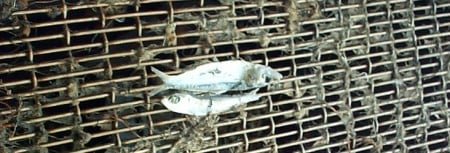
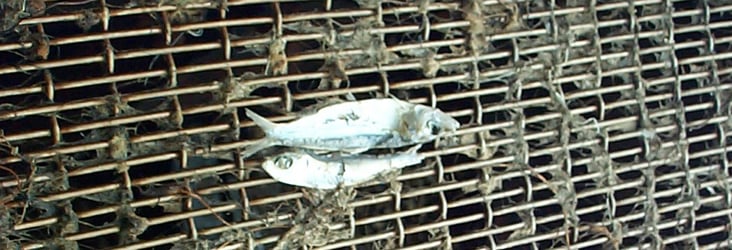
Power plants kill fish in staggering numbers. Every year, power plants withdraw more than 70 trillion gallons of water from U.S. oceans, rivers, lakes and reservoirs killing billions of adult and juvenile fish and shellfish, larvae, eggs and other organisms. More than 1.2 trillion gallons is withdrawn from the Hudson River by power plants alone. That’s 5 billion gallons of biologically rich tidal River water per day during times of peak use!
Power plants kill many billions of organisms each year, including a sizable portion of the Hudson’s newly spawned fish populations, by withdrawing this massive volume of water to cool their facilities and discharging heated water back into the rivers, lakes and reservoirs. These massive water withdrawals and the resulting fish mortality have been one of the Hudson River’s most contentious and important battles for almost 30 years.
Technology exists, however, that would dramatically reduce the numbers of fish killed by power plant cooling systems. Riverkeeper has fought to have this technology, known as closed-cycle cooling, installed in all Hudson River power plants. In fact, the Clean Water Act requires power plants to use the “best technology available” (BTA), which is closed-cycle cooling. This technology would eliminate 95% of the massive fish kills currently caused by the power plants.
Cooling Water Fact Sheet
-
Fish kills can be drastically reduced with state-of-the-art cooling technology. There are three types of power plant cooling systems:
- Once-Through Cooling. In this most antiquated cooling system, water is drawn from a local body of water to absorb heat and then discharged at elevated temperature. At a single large plant, this technology withdraws billions of gallons per day, and can kill billions of young fish per year. The largest user of cooling water on the Hudson, Indian Point Nuclear Generating Facility Units 2 & 3, withdraws more than 2 billion gallons per day.
- Closed-Cycle Wet Cooling. In this sylstem, cooling water is circulated first through the plant to absorb heat, then through the cooling towers to evaporate heat to the atmosphere, before being recirculated through the plant. Consuming much less water than once-through cooling, these systems still require significant volumes of water (about 8 million gallons per day at a large modern plant) to replace evaporative loss (known as “make-up”) and still cause thermal and chemical discharges to waterways (known as “blowdown”).
- Closed-Cycle Dry Cooling (a/k/a Air Cooling). This system uses radiator-type coils to transfer heat to air passing over the coils. Hybrid wet/dry cooling combines closed-cycle wet cooling with dry cooling. By adding water only occasionally for system maintenance and cleaning, dry cooling has several dramatic advantages over other cooling methods:
o It drastically reduces water requirements (requiring only about 200,000 gallons per day at a large modern plant);
o It eliminates visible plumes;
o It produces no thermal discharge to waterbodies;
o Most significantly, it decouples power plants from major water bodies, allowing siting away from aquatic ecosystems.
Dry cooling is currently in use at 60 plants in the U.S. (see the list under Related Info) and 600 worldwide. Of the new power plants currently proposed for construction in New York State, about half are slated to use dry cooling.
The positive impact of changing cooling technologies on the Hudson River is HUGE:
- Retrofitting evaporative cooling towers on a power plant using once-through cooling reduces water usage by approximately 98%.
- Switching from cooling towers to dry cooling reduces water usage by an additional 98%.
- A once-through plant using 400 million gallons per day (mgd) would use only 8 mgd with cooling towers and only 0.16 mgd with dry cooling.
For every 10,000 fish killed by a once-through plant, about 9,996 would be saved by dry cooling.